Walk into a pharmacy in London, Lagos, or Los Angeles, and the medicine on the shelf probably came from India. The country ships generic drugs to over 200 nations and produces close to 20 percent of the world’s generic medicines by volume. That figure raises a fair question. How do these companies keep quality high enough to satisfy regulators sitting half a world away?
India is now the third-largest pharma producer globally by volume. The US alone sources close to 40 percent of its generics from Indian plants. Companies like [Branded Anchor Text] sit within this larger picture, building production systems that match what international regulators expect. You can think of them as one example among hundreds working under the same demanding rules.
But meeting those expectations isn’t simple. Every country has its own rulebook. The US FDA inspects one way. The EMA does things slightly differently. MHRA looks at different details still. Indian manufacturers satisfy all of them, often within the same plant. Here’s a closer look at how they pull this off without cutting corners that could cost lives.
Compliance with International Regulatory Standards
Quality starts with paperwork. That sounds boring, but it’s the foundation everything else sits on. Most reputable Indian pharma plants hold WHO-GMP as a baseline. Top facilities also carry US FDA, EMA, MHRA, Japan PMDA, and Health Canada approvals. India has more US FDA-approved plants than any country outside the United States. That took two decades of steady investment.
Good Manufacturing Practices isn’t just a list of rules. It’s a way of running the floor. Every step from raw material intake to final packaging gets controlled, documented, and repeated identically. If you make 100 tablets today and 100 tomorrow, they need to be effectively the same product.
Regulators send inspectors, sometimes unannounced. A US FDA team can spend two weeks crawling through a facility, reading batch records, checking water systems, asking floor operators questions. One bad inspection can wipe out a year of work. Warning letters, import bans, plant closures, all real possibilities.
Documentation has gone almost fully electronic at large plants. Every action, every test result, every batch movement gets logged with a timestamp and operator ID. If a problem shows up six months after a drug ships, the company can trace it back to a specific batch, machine, and shift. Internal audits run monthly or quarterly at most companies. You don’t want a foreign auditor catching something your own QA team missed.
Advanced Quality Control and Testing
Making a drug is one thing. Proving it’s safe is another. Testing starts before production. Raw materials get sampled and checked against pharmacopoeial standards like USP, BP, and IP. A batch of paracetamol doesn’t go into the mixer until the lab confirms identity, purity, and potency.
In-process checks happen during manufacturing. Operators pull tablet samples every hour and verify weight, hardness, and disintegration time. Anything off-spec triggers a hold. The batch waits until the issue is understood.
Finished product analysis is the most extensive step. A single tablet might face a dozen separate tests. Assay measures actual active content. Dissolution checks how the drug releases. Related substances testing hunts for impurities. Microbiological testing matters especially for injectables and eye drops, where sterility is non-negotiable. Those tests can take days, sometimes weeks.
Stability testing is the long view. To claim a three-year shelf life, you have to store samples under controlled conditions and test them at set intervals of 3, 6, 12, 24, and 36 months. Accelerated studies at 40 degrees and 75 percent humidity give early warning of trouble.
Modern QC labs run on automated equipment. HPLC, mass spectrometry, automated dissolution baths, all connected to laboratory information management systems. Data integrity got serious focus after some regulatory actions in the mid-2010s, and Indian companies spent heavily to make their systems audit-ready.
Modern Manufacturing Technology
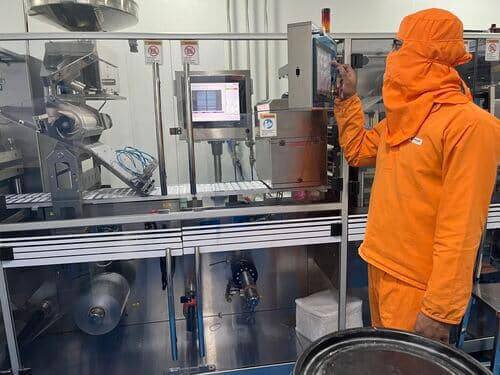
Walk into a modern Indian pharma plant and you’ll notice how few people are on the floor. That’s deliberate. Automation handles what humans did poorly. Tablet presses adjust compression force in real time. Filling lines for vials operate inside isolators where no hand touches the product. Robots move materials between rooms.
Cleanroom technology backs this up. Sterile manufacturing happens in classified environments, Grade D down to Grade A. Air changes 20 to 60 times an hour. HEPA filters catch particles down to 0.3 microns. Operators wear full gowns and pass through air showers before entering.
AI is starting to play a role, though it’s still early. Some plants use machine learning to predict equipment failures before they happen. Vision systems inspect tablets for cracks or color variation at speeds no person could match. Audit trails are reviewed regularly so deleted test results or backdated entries get flagged quickly.
Skilled Workforce and Training
Technology helps, but people still run the plants. A poorly trained operator can ruin a well-designed process. Indian pharma employs over 3 million people directly. Pharmacists, chemists, microbiologists, engineers, technicians. Large companies recruit from pharmacy colleges and put new hires through 6 to 12 months of training before they touch a production line.
Training doesn’t stop at induction. SOP refreshers happen yearly. After any deviation, the people involved go back through retraining. Culture matters as much as the rules. The best plants build this through visible leadership, open reporting of mistakes, and recognition for operators who catch issues early. If someone hides a problem out of fear, the whole system breaks down.
How important is human expertise when machines handle more of the work? Perhaps more important than before, not less. A trained chemist looking at a chromatogram sees patterns that no algorithm has been taught to flag yet.
Supply Chain and Product Safety
A drug made well in India still needs to reach Brazil or Belgium in working condition. The supply chain matters as much as the plant. Most solid oral doses travel fine at room temperature. Vaccines need 2 to 8 degrees Celsius the whole way. Some biologics demand minus 70. Cold chain logistics is its own discipline. Reefer containers, validated shipping lanes, temperature loggers running the entire journey. If insulin sees 30 degrees for four hours, the batch may be lost.
Batch tracking is the safety net. Every pack carries a batch number, and modern serialization adds a unique 2D barcode per unit. If a quality issue surfaces after launch, the company recalls only the affected production runs, not every box on the market. A pharmacist in Kenya can scan a pack and confirm it came from a real plant rather than a counterfeit operation.
There was a case some years back where a serialization system flagged fake antimalarials being passed off as Indian-made. The holograms looked real, but the codes didn’t match the manufacturer’s database. The supply chain caught it before many doses reached patients. That kind of outcome is worth the investment.
What This Means Going Forward
India’s pharma industry didn’t earn global trust by accident. It took decades of building plants, training people, surviving inspections, and learning from real failures along the way. Quality is the sum of dozens of small decisions made daily by operators, lab analysts, and managers. Regulations set the floor. Technology brings consistency. Trained people catch what machines miss. Supply chains protect the product until a patient takes it.
Looking for a reliable pharmaceutical manufacturing partner in India? Pick companies with internationally recognized certifications and transparent quality practices. The credentials are public and checkable. Ask to see them.
FAQs
What quality certifications do Indian pharmaceutical companies follow?
Most carry WHO-GMP as a baseline. Larger exporters also hold US FDA, EMA, MHRA, PMDA, and Health Canada approvals depending on which markets they ship to.
How do Indian pharma manufacturers comply with FDA standards?
They build facilities to current Good Manufacturing Practices, run validated processes, maintain electronic batch records, and undergo regular FDA inspections, both announced and surprise.
Why is GMP important in pharmaceutical manufacturing?
GMP makes sure every batch is produced under controlled conditions so quality stays the same from one production run to the next. Without it, dosage strength and purity could vary.
How is medicine quality tested before export?
Raw materials get tested on arrival, products get tested at multiple stages during manufacturing, and finished batches go through assay, dissolution, impurity, and microbiological testing before release.
Are Indian pharmaceutical products accepted globally?
Yes. Indian-made drugs reach over 200 countries and supply close to a fifth of the world’s generic medicines.
What technologies improve pharmaceutical quality control?
HPLC, mass spectrometry, automated dissolution testing, vision inspection systems, LIMS for data capture, and machine learning for predictive monitoring.