Most people use the words “pharmaceutical” and “medicine manufacturing” interchangeably. That is understandable — from the outside, both seem to do the same thing. Make drugs. Supply hospitals. Keep the healthcare system running.
But if you are a pharmaceutical brand, a healthcare entrepreneur, or someone evaluating a manufacturing partner, the difference matters more than you might think. A company like VibCare Healthcare, for instance, operates as a contract medicine manufacturer — producing finished formulations for brands that want to launch products without building their own plant. That is a very specific function, and it is quite different from what a full pharmaceutical company does.
Understanding where one ends and the other begins can save you a lot of time, and perhaps a few costly mistakes.
What Pharmaceutical Manufacturing Companies Actually Do
Pharmaceutical companies are, at their core, science-driven businesses.
Their primary focus is not just making medicines — it is discovering, developing, and then manufacturing them. That process is long, expensive, and deeply regulated. A pharmaceutical company typically runs clinical trials, develops new drug molecules or formulations, files patents, and works with regulatory authorities to get new treatments approved for market.
The work includes:
- Active Pharmaceutical Ingredient (API) development and synthesis
- Pre-clinical and clinical research
- Formulation development (figuring out how a drug should be delivered — tablet, injection, patch, etc.)
- Large-scale production of prescription medicines, vaccines, and biologics
- Post-market surveillance and pharmacovigilance
This is where blockbuster drugs come from. The kind that treats cancer, manages autoimmune conditions, or prevents viral diseases. The research pipeline at a major pharmaceutical company can run for 10 to 15 years before a product reaches a patient.
And that pipeline costs billions.
Not every company in the pharma world operates at this scale, of course. But the defining characteristic of a pharmaceutical company is that it is involved in creating something new — not just reproducing an existing formulation.
What Medicine Manufacturing Companies Do
Medicine manufacturers work on a different part of the chain.
Their job is production. They take existing formulations — approved, established, often off-patent — and manufacture finished medicines at scale. This means tablets, capsules, syrups, ointments, injections, and other dosage forms that end up on pharmacy shelves or in hospital dispensaries.
Think about the medicines you use regularly. Paracetamol. Antacids. Vitamin supplements. Antibiotic syrups for children. Most of these are not being “invented” anymore — the science is settled. What needs to happen is consistent, compliant, large-scale production.
That is where medicine manufacturers come in.
They work from existing drug masters and approved formulations. Their focus is on:
- Manufacturing quality and batch consistency
- Regulatory compliance (GMP, WHO-GMP, ISO certifications)
- Packaging and labelling
- Supply chain reliability
- Cost-effective production at varying volumes
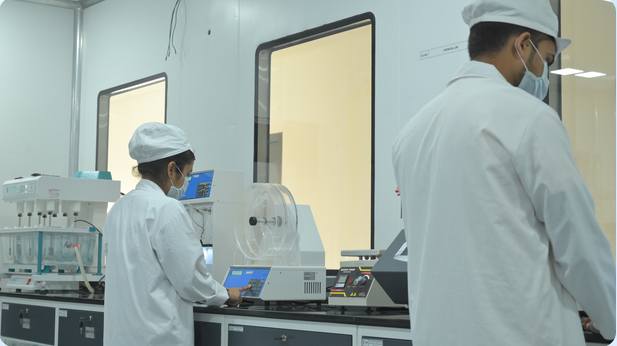
For pharmaceutical brands that want to launch a product but do not want to build a factory — which, frankly, most brands do not — a medicine manufacturer handles the entire production side. The brand focuses on marketing, distribution, and sales. The manufacturer handles everything else behind the lab door.
The Key Differences, Side by Side
Here is where it gets clearer.
| Feature | Pharmaceutical Companies | Medicine Manufacturing Companies |
| Core focus | Research, development, and production | Production of finished medicines |
| R&D involvement | Central to operations | Minimal or none |
| Products | New drugs, APIs, vaccines, biologics | Tablets, capsules, syrups, OTC products |
| Regulatory pathway | Drug approvals, patents, clinical trials | GMP compliance, manufacturing licences |
| Capital requirement | Very high | Moderate to high |
| Time to market | Years | Weeks to months |
| Client relationship | Internal or licensing-based | Contract and third-party manufacturing |
The scope of a pharmaceutical company is broader and, frankly, riskier. A lot of R&D investment never produces a marketable product. Medicine manufacturers carry less of that risk — they are producing things the market already wants, using formulations that already work.
That said, medicine manufacturers carry their own pressures. Quality failures at the production level can result in product recalls, regulatory action, and real harm to patients. The margin for error is low, even if the scientific uncertainty is smaller.
How the Two Work Together
They are not competitors. They depend on each other.
A pharmaceutical company might develop a new formulation for a particular therapeutic area — say, a novel combination tablet for cardiovascular conditions. Once that formulation is approved and ready for market, the pharmaceutical company may not want to invest in production capacity, especially for markets outside their core geography.
So they partner with a medicine manufacturer.
The manufacturer produces the finished product to specification, meets the required quality standards, and delivers at scale. The pharmaceutical company maintains the brand and the intellectual property. Both benefit.
This kind of collaboration is also how newer brands enter the market. An entrepreneur with a strong idea for a nutraceutical range or a generic medicine brand does not need to build a plant. They need the right manufacturing partner. The medicine manufacturer brings the facility, the regulatory approvals, and the production expertise. The brand brings the market strategy and distribution network.
The system, when it works well, gets medicines to patients faster and at lower cost than either party could manage alone.
Choosing the Right Manufacturing Partner (For Brands Evaluating Their Options)
If you are a pharmaceutical brand looking to outsource production, this distinction should directly shape how you evaluate potential partners.
A few things to look for:
Certifications and regulatory approvals WHO-GMP certification is a baseline requirement for any serious manufacturer. It signals that the facility meets international production standards — not just local ones. Look for additional approvals from USFDA, EMA, or other relevant bodies depending on your target market.
Manufacturing capabilities Does the manufacturer produce the dosage forms you need? Tablets are not the same as soft gelatin capsules. Oral liquids require different equipment and clean room standards than topical preparations. Confirm that their facility actually handles what you plan to launch.
Quality control systems Ask about in-house testing labs, stability studies, and how they handle batch failures or deviations. A manufacturer who cannot clearly explain their quality processes is a risk you do not need.
Production capacity and flexibility Some brands start small. Others scale quickly. You want a partner who can handle both — low minimum order quantities at the start, and the production bandwidth to grow with you.
Transparency in communication Perhaps this sounds obvious. But a manufacturing partner who goes quiet when problems arise, or who gives vague answers about timelines, will cost you more than a slightly higher price per unit ever would.
Take your time evaluating this. The wrong manufacturing partner can delay your product launch, damage your brand reputation, or worse — put unsafe medicine into circulation. That last risk, in particular, is not something to take lightly.
Frequently Asked Questions
Are pharmaceutical companies the same as medicine manufacturers?
Not exactly. Pharmaceutical companies typically focus on drug research and development, while medicine manufacturers mainly produce finished medicines using existing formulations.
What do pharmaceutical companies manufacture?
They develop and produce drugs, vaccines, APIs, and advanced therapies, often through long research and clinical trial processes.
What types of products do medicine manufacturing companies produce?
Tablets, capsules, syrups, ointments, injections, and other finished dosage forms that reach patients through pharmacies and hospitals.
Can one company be both a pharmaceutical and medicine manufacturer?
Yes. Several large companies handle both drug development and contract production. Smaller players tend to specialise in one or the other.
Why does this difference matter for businesses?
It determines which kind of partner you need. If you are developing a new molecule, you need a pharmaceutical company. If you are launching a finished product brand, a medicine manufacturer is your partner.