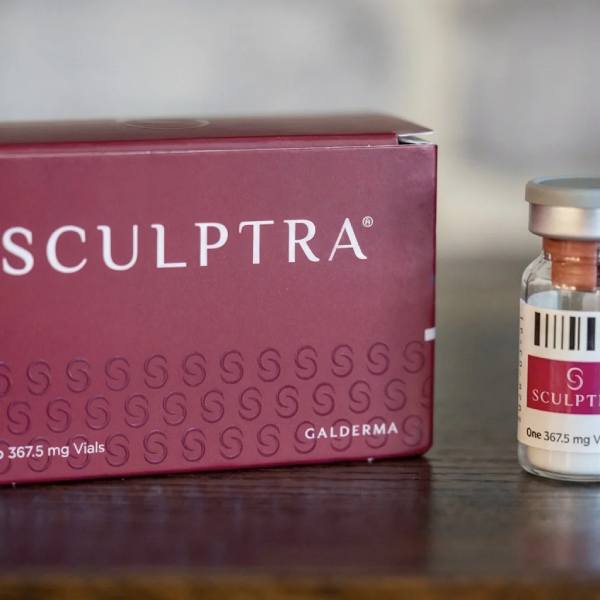
Everybody walks into the consultation hoping for the magic syringe to solve all problems by the weekend. This kind of thinking is understandable; after all, dermal fillers have been marketed that way for decades. Insert, plump up, wait out, and that’s it. But Sculptra doesn’t fit the usual pattern, and people who are pleased with the treatment’s results know that. The reason isn’t how the product is marketed; it’s the biological effect Sculptra produces.
The short version would be that fillers fill volume. With Sculptra treatments, the procedure requires you to recreate that volume yourself. The active ingredient – Poly-L-lactic acid – is not a volumizer in any way.
What Poly-L-Lactic Acid Actually Does in the Skin
Sculptra is made from poly-L-lactic acid, a biodegradable synthetic that has been used in dissolvable sutures for decades. When placed in the deeper layers of the skin, the particles create a controlled irritation. Fibroblasts respond. Collagen production increases in the treated area over weeks to months. The product itself breaks down and leaves. What stays behind is the collagen that your own tissue built. This is why practitioners at Savage Serenity MedSpa spend so much consultation time on timeline rather than volume.
A patient who wants a fuller cheek by Saturday is not a Sculptra patient. An individual seeking to have his mid-face structurally supported in five months, with no more pillowy face from yearly filler injections, most likely qualifies.
Differences Between Sculptra Procedures and HA Fillers
The difference always seems to get muddled, so allow me to clarify.
- Mode of Action. HA fillers increase volume through injection. Sculptra makes your body produce collagen.
- Onset. Filler results appear immediately. Sculptra results build gradually, usually becoming noticeable somewhere around the six-to eight-week mark and continuing to develop.
- Reversibility. Hyaluronic acid can be dissolved with hyaluronidase. Sculptra cannot be reversed the same way, because there is nothing to dissolve once the collagen is yours.
- Longevity. Filler is typically measured in months. Collagen stimulation tends to hold longer, though nothing here is permanent.
- Number of sessions. Filler is often one appointment. Sculptra usually requires a series, spaced several weeks apart.
That last point deserves attention. People hear “series” and assume upselling. The spacing exists because collagen takes time to form, and a practitioner cannot assess how much you have built until you have actually built it. Treating too aggressively too early is how patients end up overcorrected.
Why Volume Is the Wrong Way to Think About Sculptra
There is a fear underneath most aesthetic consultations, and it rarely gets said out loud. People are not afraid of looking older. They are afraid of looking worked on.
Everyone has seen the face that reads as treated from across a room. Cheeks that sit slightly too high. A midface that looks inflated rather than supported. That look almost never comes from one bad appointment. It comes from years of chasing volume with a product designed to occupy space, in a face that was actually losing structure.
Sculptra approaches the same problem from underneath. It addresses the foundation, the collagen scaffold that thins as we age, rather than propping up the surface. The result, when it goes well, is that nobody can identify what you have done. They just think you look rested.
That is the honest appeal, and it is worth being candid about it.
Who Sculptra Treatments Suit, and Who They Do Not
Sculptra tends to work well for:
- Gradual midface volume loss, particularly in the temples and cheeks
- Patients who want a slow, unremarkable change rather than a visible before and after
- People who dislike the look or feel of stacked filler
- Anyone thinking in terms of years rather than events
Sculptra is a poor match for:
- A specific date on the calendar within the next two months
- Precise, small-area shaping where a defined result matters, such as detailed lip work
- Patients who want the ability to reverse the result quickly if they dislike it
- Anyone who struggles with the idea of paying now for something they will see later
That final point is real, and it is where the most disappointment comes from. Paying for a treatment and then looking in the mirror three weeks later, unchanged, feels terrible. Patients who are told to expect that beforehand handle it fine. Patients who are not told feel cheated, and understandably so.
What the Timeline Looks Like in Practice
The reconstituted product is injected, and there is often a small amount of immediate swelling from the fluid volume. That swelling is not your result. It goes away within days, and many patients quietly panic at this stage, thinking the treatment failed.
Nothing failed. The collagen response has simply started.
From there, changes build slowly. Some patients notice something at four weeks. Most notice around two to three months. Follow-up sessions are typically spaced roughly six weeks apart, with the number depending on how much structural loss existed at the start.
Post-treatment massage of the area is standard aftercare, and it matters. Follow the instructions you are given.
Questions Worth Asking Before You Book
Bring these to a consultation and listen carefully to the answers.
- Is my volume loss structural, or is it a surface concern that a different treatment would handle better?
- How many sessions do you anticipate, and why that number?
- What will I look like at week three, and how will I know things are working?
- What happens if I dislike the result, given it cannot be dissolved?
A practitioner who answers question four with a shrug is not the practitioner for you.
The Honest Takeaway
Sculptra treatments reward patience and punish urgency. The product does not fill anything. It convinces your face to rebuild what time removed, and that process runs on a biological clock nobody can speed up.
If you want a result you can see tomorrow, this is the wrong choice, and any good injector will tell you so. If you want to look like yourself in three years without anyone being able to explain why, the slower path is the one worth walking.
Talk to a qualified injector about whether your facial structure suits collagen stimulation. Ask about the timeline. Then decide whether you have the patience for it, because the treatment works far better for people who do.